
The common perception is that consultants are the expensive option. So for many companies, they are rarely the first choice either. But we’d like to add a little nuance to that.
A cost analysis
A contractor at DKK 850 an hour. A permanent employee at DKK 60,000 a month. At first glance, the contractor costs almost twice as much. But dig a little deeper into the numbers and the picture looks somewhat different, even though the contractor is still the more expensive option as long as we measure it only in hard cash.
We calculated what it costs to fill one role for one year under each model. The example is a financial controller with five years’ experience, and we have tried to include every cost: the ones on the payslip and the ones hidden in day-to-day operations.
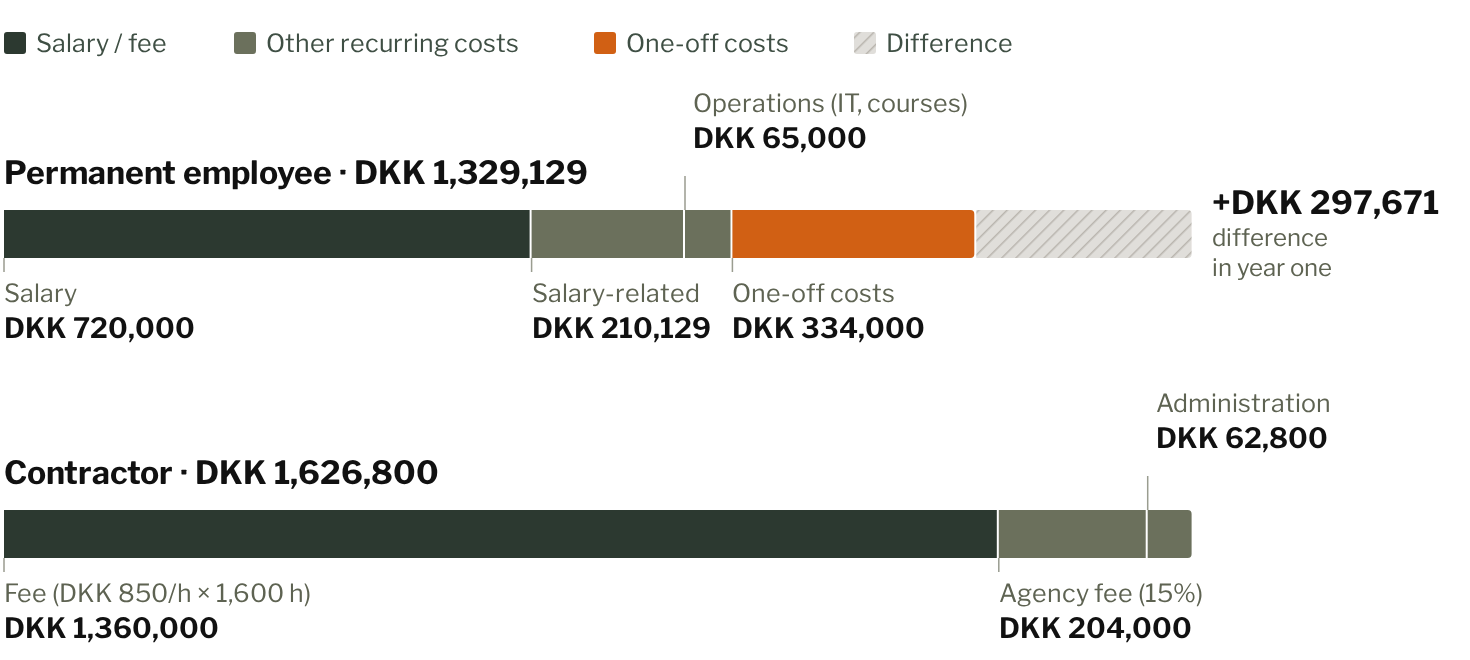
What does a permanent employee cost in the first year?
Salary is the biggest item, but far from the only one. Pension, holiday pay and statutory contributions sit on top of the gross salary. Then come the operating costs that rarely make it into the comparison with a contractor.
- Gross salary (12 months): DKK 720,000
- Employer pension contribution (10%): DKK 72,000
- Holiday pay (12.5%): DKK 90,000
- ATP and other statutory contributions (AES/AER/FIB): DKK 12,048
- Sick leave (8.5 days): DKK 27,818
- Parental leave risk (5%, 24 weeks): DKK 8,263
- Workspace and IT: DKK 35,000
- Courses, certification and events: DKK 30,000
- Recruitment: DKK 150,000
- Onboarding and training: DKK 40,000
- Lost productivity in year one (20%): DKK 144,000
Total: DKK 1,329,129
The last three items in particular are often forgotten. Recruitment, onboarding and lost productivity add up to DKK 334,000. Lost productivity reflects the fact that a new employee has to get to know the organisation, the systems, the customers, the competitors and the work itself before they can deliver in full. It can be hard to put an exact figure on it, but a widely held assumption is that a new employee only delivers full value after 6–9 months. So in some contexts, 20% may be on the low side.
What does an interim consultant cost per hour, all things considered?
For the contractor, the picture is simpler. The fee makes up most of it, and the rest is administration around the agreement. We assumed 1,600 billable hours in a year.
- Consultant fee (DKK 850/h × 1,600 h): DKK 1,360,000
- Agency or broker fee (15%): DKK 204,000
- Internal coordination (7 h/month at DKK 450): DKK 37,800
- Legal and contract administration: DKK 10,000
- Workspace and IT: DKK 15,000
Total: DKK 1,626,800
That gives a real hourly rate of DKK 1,017, around 20% more than the consultant’s hourly rate. Internal coordination in particular is easy to overlook. After all, someone in the organisation still has to align tasks, follow up and keep the consultant up to date.
The gap is smaller than the hourly rate suggests
Compare fee with salary, and the contractor costs 89% more. Compare total costs, and the difference is just under DKK 300,000, or 22%.
That’s still money, and a lot of it. But it is a different basis for a decision than the one you get by holding the hourly rate up against the payslip.
The calculation only covers year one, though. In year two, the one-off costs of recruitment, onboarding and lost productivity fall away, bringing the permanent employee down to around DKK 1.0 million, while the gap grows to roughly DKK 630,000.
What the numbers don’t capture
Some of the risks of using consultants can’t be priced, but they still belong in the assessment.
Scope creep. An unclear statement of work, or a project that grows along the way, can lead to unexpected invoices or tasks left unsolved. The sharper the agreement from the start, the smaller the risk.
Cultural and competence fit. If the consultant isn’t the right fit, finding a new one is faster and cheaper than replacing a permanent employee. But a switch halfway through an assignment still costs momentum.
Knowledge building. A permanent employee builds knowledge that stays in the organisation. With a consultant, much of it leaves when the contract ends, unless there is a plan for handover.
Interim or permanent: when should you choose which?
The analysis points to two factors that decide it: time horizon and appetite for risk.
Choose a consultant if you’re unsure whether the need extends beyond a year. Here the consultant wins on flexibility and isn’t far behind the permanent employee on price. That might be a project with an end date, a gap to cover during a recruitment process, or a period of organisational change.
Choose a permanent employee if you know the need is long term. Then the permanent hire wins on total cost and culture, and the knowledge built up stays in-house.
How we calculated
The calculation covers one year for a financial controller with five years’ experience. It assumes that the first year of employment carries extra costs that don’t recur in the following years.
Sources
- Salary statistics: Djøf, financial controller with 5 years’ experience
- Pension, holiday pay and overhead: HK, Dansk Erhverv, DA 2024
- Parental leave: DA Barsel, reimbursement cap DKK 250.16/h (2025)
- Sick leave: Confederation of Danish Employers (DA) 2025
- Contract management: World Commerce & Contracting
- Productivity loss: Talents Unlimited
Facing a role where you don’t know if the need is temporary or permanent? Spitze helps with both recruitment and interim, and we’re happy to talk through what makes sense in your situation.